

brand collaboration has become increasingly common in an era saturated with partnerships, making it easy to dismiss some collaborations as fleeting gimmicks or glorified merch drops. but when done right, co-branding projects can transcend trend cycles and spark meaningful cultural conversations. true success lies in the balance between aesthetics, strategy, and purpose—not just slapping two logos on a hoodie.
two collaborations, IKEA × virgil abloh and adidas × gucci—stood out in recent years for their ability to reshape consumer expectations and redefine creative synergy. more than just successful product launches, these brand partnerships ignited movements and rewrote the rules of how brands should think about co-creation. here’s how they did it.
Brand Collaboration: IKEA × Virgil – From Flatpack to Collectible
when ikea, the world’s most ubiquitous home goods retailer, announced a creative collaboration with virgil abloh in 2019, many were skeptical. the late off-white founder and louis vuitton men’s artistic director was known for redefining streetwear, not sofas. but the 15-piece markerad collection quickly proved this wasn’t a superficial partnership; it was a conceptual and commercial breakthrough.
virgil brought his now-iconic design language—quotation marks, visual irony, and subtle cultural commentary, to ikea’s blank canvas of functional furniture. a green rug printed with the words “wet grass,” a clock labeled “temporary,” and a doormat that warned visitors to “keep off” weren’t just decor; they were layered statements about value, impermanence, and youth culture, turning product design into a form of brand storytelling.
what made markerad so impactful was abloh’s deeper mission: to democratize design. he wanted a 17-year-old in indiana to own something thoughtfully made and conceptually rich without breaking the bank. that commitment aligned perfectly with ikea’s ethos of affordability and accessibility. but it was abloh’s freedom to create, without dilution, that made the collection feel authentic. ikea didn’t dilute his aesthetic or reduce his contribution to branding. they handed him the keys and let him drive.
critics called the pieces ironic. fans called them collectible. and both were right. the collection sold out instantly, flooded resale markets, and remains a cultural timestamp—a rare moment when furniture, art, and fashion collided in perfect symmetry.
Brand Collaboration: Adidas × Gucci – Luxury Meets Streetwear
if Virgil and ikea were about disrupting minimalism, the 2022 brand partnership between Adidas and Gucci was an opulent celebration of maximalism. The collaboration arrived at the height of streetwear’s integration into high fashion and offered a bold answer to a lingering question: Can luxury and sportswear coexist without compromise?
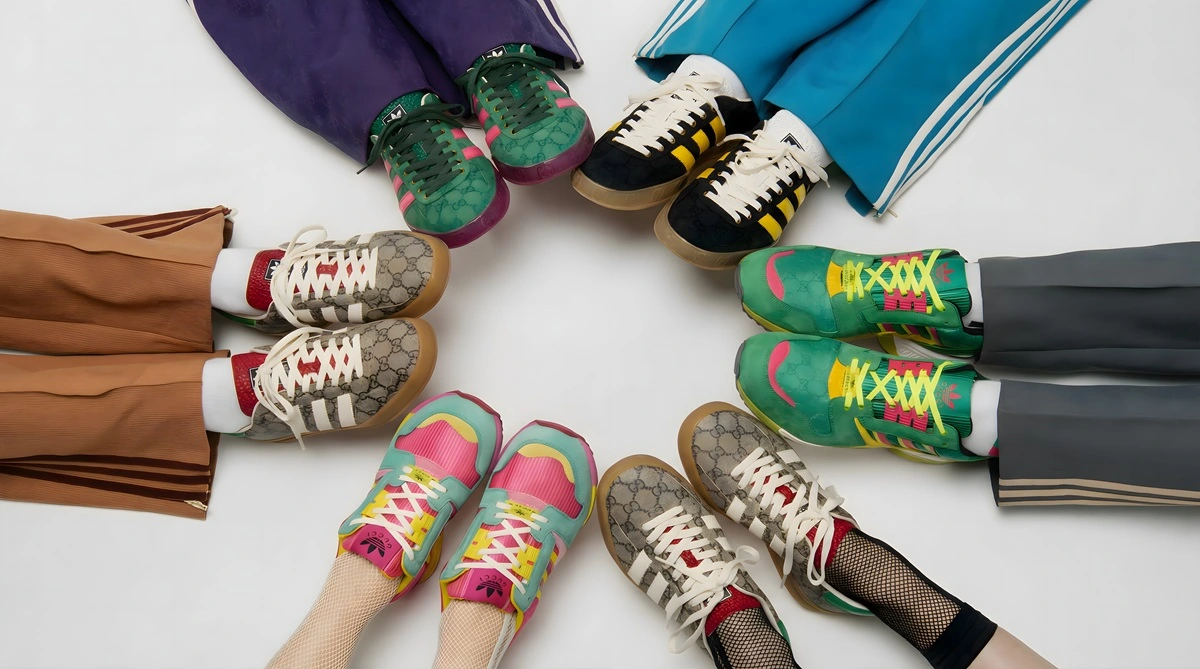
under alessandro Michele’s direction, the adidas × gucci collection was a masterclass in visual storytelling and archival remixing. Far from just logo mashups, the pieces fused Adidas’s sports heritage with Gucci’s flair for the retro. Cricket-style track jackets, velvet Gazelle sneakers, and monogrammed steamer trunks didn’t just carry both brand identities; they celebrated them.
michele, a long-time adidas gazelle collector himself, made sure the collab was rooted in his personal fashion history. his passion for sportswear added depth, and gucci’s craftsmanship elevated each item from gear to artifact. the debut, held at milan fashion Week during Gucci’s “exquisite” show, immediately established the collaboration as a cultural event, not just a product drop.
but the partnership also had teeth in the numbers. In July 2022, questBrand reported a 3.7-point increase in gucci’s consumer favorability and a 3.2-point rise for Adidas. Adidas saw a jump in perceived quality (+6.4) and purchase consideration (+4.3), while gucci gained trial (+7.1) and usage (+6.0) among new consumer segments. these weren’t just vanity metrics; they signaled a mutual expansion of brand equity across previously untapped audiences.
even more importantly, later iterations of the collection integrated demetra, gucci’s bio-based leather alternative. The rollout of biotech materials, paired with careful narrative pacing through campaigns and flagship drops, reflected a rising awareness of environmental luxury and strengthened the collection’s brand positioning. this wasn’t a one-season gimmick. It was a redefinition of what the next decade of premium streetwear might look like.
Rules of a Great Collab: Equity, Timing, and Purpose
what separates a brand collaboration that lives on mood boards from one that lives in people’s homes or closets? It boils down to three interlocking factors: creative equity, cultural timing, and purpose.
creative equity is about true authorship. virgil Abloh was not “featured” by ikea; he was trusted as a co-author with conceptual control. every piece bore his fingerprint, not just his name. The same goes for Michele’s stewardship of adidas × gucci. It was a designer-led project, not a business maneuver handed down by marketing departments. This creative freedom is rare but essential to any collaboration that aspires to meaning.
timing is also crucial. the ikea × virgil abloh collection dropped as youth culture was undergoing a renaissance in design thinking. tiktok and pinterest were flooded with diy interiors and streetwear-inspired living spaces. virgil’s pieces arrived at the exact moment when young people wanted furniture that felt like self-expression. meanwhile, the adidas × gucci collection capitalized on streetwear’s full immersion into the luxury ecosystem. it landed not as a novelty but as a logical next step in fashion’s evolution.
finally, purpose separates fluff from legacy. both collaborations had something to say. abloh wanted to demystify good design for young people. adidas and gucci wanted to prove that style and sustainability were no longer mutually exclusive. these projects weren’t just chasing attention; they were articulating values.
How Brand Collaboration Uses Drop Culture to Create Demand
scarcity isn’t just a sales strategy; it’s a cultural amplifier. when executed correctly, it becomes a vehicle for storytelling and community engagement.
ikea × virgil abloh embraced drop culture in a way few furniture brands ever had. items sold out in minutes. resale markets exploded with triple-digit markups. these weren’t ordinary chairs and rugs; they were artifacts of a cultural moment. the limited nature of the launch gave them weight and made ownership feel like participation in something larger.
adidas × gucci used a similar strategy, albeit at a different scale. launching during milan fashion week gave the collaboration prestige. later drops, featuring biotech materials, new silhouettes, and limited inventory, kept the excitement alive while aligning with sustainability goals. the scarcity of the collection wasn’t artificial. it was an intentional part of its value.
brand storytelling played a pivotal role. both brands used slow-reveal tactics, influencer partnerships, and curated rollouts to generate organic anticipation. in each case, the resale ecosystem acted like a barometer: if people are willing to pay above retail long after the launch, something deeper than hype is at work.
Commercial Outcomes and Long-Term Brand Value
while immediate sell-through and media buzz are important, the true success of a collaboration is measured by what lingers: how it reshapes brand perception and sets new expectations.
for adidas, the collaboration with gucci strengthened its brand positioning as a legitimate player in the luxury-meets-sport conversation. it also justified premium price points in future collections by demonstrating craftsmanship and innovation. it showed that a performance brand could play in the same sandbox as heritage fashion houses without losing credibility.
gucci, on the other hand, gained access to a younger, more global consumer base. the brand maintained its identity while expanding its reach. this wasn’t a dilution; it was a recalibration. gucci didn’t become adidas. it became bigger than just gucci.
as for ikea, the impact was even more profound. with one collection, the brand shifted its image from utilitarian to culturally relevant. virgil abloh’s designs are now featured in design retrospectives and art museums. for an affordable homeware brand, that’s legacy-level impact.
these collaborations show that when execution is aligned with purpose, even the most commercial ventures can deliver cultural meaning. they become part of the timeline, not just part of the catalog.
Co-Creation Done Right
If there’s one lesson from IKEA × Virgil Abloh and Adidas × Gucci, it’s this: successful brand collaborations are not marketing tactics. They are shared acts of creation, rooted in trust, timing, and purpose. They don’t chase hype; they shape culture.
Let these collaborations be more than case studies. Let them be reminders that branding, at its best, is not just about visibility but about voice. It’s not just about what you sell, but what you stand for, who you build with, and how that creation echoes long after the headlines fade.